Call for expression of interest: General partner for Pan-African secondary fund
This call is issued as a market engagement exercise and does not constitute a formal procurement process. The Taskforce reserves the right to engage additional candidates outside this process and to modify or discontinue the process at any time.
This call is issued as a market engagement exercise and does not constitute a formal procurement process. The Taskforce reserves the right to engage additional candidates outside this process and to modify or discontinue the process at any time.
1. Background and context
In mature private markets, dedicated secondary vehicles are a structural feature of the ecosystem providing the liquidity infrastructure that allows primary capital to be recycled, fund lives to be managed, and limited partner (“LP“) portfolios to be actively rebalanced. According to the Jefferies Global Secondary Market Review (January 2026), global secondary transaction volume reached a record USD 240 billion in 2025 — a 48% year-on-year increase — reflecting a deep, institutionalised market in which secondary transactions are a routine instrument of active portfolio management. Africa has no equivalent infrastructure: secondary transaction activity on the continent remains nascent, with no dedicated secondary vehicle at scale and a buyer-seller market estimated to represent a fraction of one per cent of global secondary volume.
The consequences of this gap are significant: According to AVCA’s 2025 African Private Capital Activity Report, Development Finance Institutions (“DFIs”) account for approximately 64% of total fundraising by African funds, a figure that rises further for first-time managers, frontier market-focused funds, and impact-oriented vehicles, where DFIs frequently provide anchor commitments and first-close capital to crowd in additional investment. This concentration reflects the limited participation of commercial and institutional investors, who require demonstrated exit performance and credible return benchmarks before committing capital at scale. Attracting a broader and more diversified LP base is widely seen as essential to the long-term health of the ecosystem, but doing so requires a track record of exits and commercial returns that the market has so far struggled to generate. The absence of a functioning secondary market is both a symptom and a cause of this challenge.
GIZ’s Innovative Capital Mobilisation in Africa (“ICAMA”) Initiative, together with MEDA (together, “the Taskforce“), is conducting a feasibility study to assess whether a Pan-African Secondary Fund (“the Fund“) is viable and to design its strategic and structural foundations, including a market scoping. CrossBoundary (“CB“) has been engaged as lead adviser on this assignment.
Through this Call for Expressions of Interest, the Taskforce and CB are now inviting qualified fund managers to express their interest in serving as general partner (“GP“) of the Fund, co-developing its structure and strategy before independently managing and fundraising for the vehicle.
2. Overview of the secondary liquidity gap in African private markets
Secondary transaction volume on the continent is estimated at well below USD 100 million per annum, and no dedicated secondary vehicle exists at scale. A structural mismatch between standard ten-year fund lives and the longer development timelines of African portfolio companies has produced a growing stock of unrealised assets, a large proportion of fund managers now beyond their initial investment periods and reporting limited exit activity. Addressing this liquidity deficit serves as a vital precondition for broadening the investor base and demonstrating that African private markets can deliver commercial returns.
Market soundings conducted as part of this feasibility study — covering GPs, DFIs, institutional LPs, secondary market intermediaries, and ecosystem participants — produced several findings that inform the scope of this call.
First, a broad consensus exists among practitioners that the most compelling opportunity lies in performing, de-risked assets rather than distressed or tail-end positions. Secondary buyers, including those with an emerging market or impact mandate, consistently seek assets with demonstrated business models, credible growth trajectories, and realistic exit paths. While tail-end and distressed positions are addressed by certain specialist players, the proposed vehicle should be oriented towards catalysing broader private capital mobilisation, designed to demonstrate that African private markets can generate commercial returns on quality secondary assets. A successful vehicle of this nature would serve not only as proof of concept for the asset class but as a catalyst for attracting additional secondary capital to the continent — laying the groundwork for a more diversified and self-sustaining secondary market in Africa.
Second, a GP-led mandate (i.e. direct secondaries), or a hybrid combining GP-led and LP-led structures, is viewed as better suited to African market conditions than a pure LP-led secondary approach due to the (1) DFI-dominated LP base, (2) the importance of maintaining governance rights over underlying assets, (3) and the need for deep local relationships to originate and price transactions.
Third, price discovery remains the central execution challenge. Buyers without deep market knowledge apply substantial discounts as a default risk premium; buyers with established African networks transact at materially tighter discounts on quality assets. Structuring tools — including deferred payment mechanisms and earn-out provisions— are viewed as important instruments for bridging the bid-ask gap.
Based on market soundings to date, the Taskforce’s working assumption is that a viable vehicle would focus on top-quartile assets in the late-stage venture capital and early growth phase, targeting companies in years five to eight of their development, where a partial or full secondary transaction can provide liquidity to existing investors while preserving upside for a new holder. The indicative fund size is currently established in the range of USD 100–200 million. The Taskforce is open to a structure that allocates a small portion of capital to primary investment when such investment would materially accelerate a portfolio company’s path to exit and enhance overall returns and better align with impact measurement frameworks.
These above parameters are indicative, and respondents are invited to comment on them directly.
The Fund is expected to operate in full compliance with DFI investment standards. At a minimum, the Taskforce anticipates applying the IFC Exclusion List as the baseline investment exclusion framework, which bars investment in activities such as weapons production, tobacco, and activities involving child or forced labour. Detailed ESG requirements and impact measurement frameworks will be developed in collaboration with the selected GP during the co-creation phase.
3. Scope of this call and respondent profile
This call is directed at fund managers with a credible basis for managing a Pan-African secondary vehicle. The Taskforce invites qualified managers to set out, at a high level, how they would approach the mandate described in this document, whether they would be interested in managing such a vehicle, and what they would need to do so. Please note, however, this call does not seek general market commentary or advisory input.
Relevant respondents may include managers with direct experience of secondary transactions in African or comparable emerging markets, pan-African investment platforms with established GP relationships and deal origination networks, and international managers with a demonstrable secondary track record who can articulate a credible path to building the local presence and relationships this mandate requires. The Taskforce is also open to joint submissions from a consortium with complementary experience — for example, a manager with an established secondary track record paired with a manager with deep African market presence and GP relationships — provided the submission clearly sets out how the partnership would be structured and governed. Respondents are encouraged to be candid about the boundaries of their experience and to explain how they would address any gaps.
What the Taskforce offers the selected GP
The Taskforce and CB will provide the following support to the selected GP during the co-creation and fund launch phase:
- Access to all findings, datasets, and analysis produced as part of the feasibility study, including market sizing, fund universe mapping, and market sounding outputs.
- In-kind advisory support from CrossBoundary during the initial fund structuring phase, including engagement with legal counsel and fund administrators identified through the feasibility study.
- Access to GIZ ICAMA’s convening power and DFI network to support early investor engagement and fundraising discussions.
- Co-facilitation of introductory discussions with potential anchor LPs, including MEDA (Fund Manager of the Mastercard Foundation Africa Growth Fund and MEDA Risk Capital Fund), which is currently considering participation in the Fund.
The Taskforce does not offer grant funding, first-loss capital, or any form of financial guarantee to the selected GP. The GP will be expected to independently manage and fundraise for the vehicle on commercial terms. The co-creation process is time-bound and is expected to conclude by the end of the first quarter of 2027, after which the GP assumes full operational responsibility for the Fund.
4. Questions to respondents
The Taskforce seeks responses to the following questions. However, it views them as a guide rather than a very rigid template. Where information is commercially sensitive, high-level characterisations or indicative ranges are entirely acceptable at this stage. No bespoke materials are required — a concise written response of ideally around five pages addressing the questions below is sufficient. Respondents are welcome to attach and reference an existing firm overview or investor presentation as a supplement; this is optional and does not substitute for a direct response to the questions. Font size, structure and document format are deliberately left open.
Part A — Strategic proposition and approach
- A.1 Investment strategy. Based on the problem statement set out in this document, where do you see the most compelling opportunity — GP-led secondaries, LP-led secondaries, or a hybrid approach? Please state your preferred strategic focus and the reasoning behind it, including any views on geographic or sectoral concentration.
- A.2 Target segment and fund size. What asset and company profile would you target in terms of development stage, sector(s), and geography? Do you agree with the indicative fund size range of USD 100–200 million, and what would be your view on optimal fund size given current market conditions? Please also share your indicative views on fund term and target return expectations. The Taskforce is also considering whether a small allocation of primary capital — alongside the secondary mandate — could accelerate portfolio companies’ path to exit and enhance overall fund returns as well as LP appetite. Please share your view on whether such a sleeve would be appropriate and, if so, how it should be sized and governed.
- A.3 Deal sourcing. How would you expect to originate transactions in African markets, where formal deal processes are limited and pricing benchmarks are thin? Please describe your approach to pipeline development and the ecosystem relationships you would draw on to identify and access relevant opportunities.
- A.4 Pricing, valuation and exit strategy. How would you approach NAV assessment and discount discipline given the limited exit comparables in African markets? What structuring tools would you consider to bridge the bid-ask gap? Critically, please describe how you would approach exit planning from the point of asset selection — including the exit pathways you would target, the networks and relationships you would deploy. The Taskforce views active exit management as central to the mandate and will prioritise candidates who can demonstrate a clear and credible approach to achieving realisations within a defined timeframe.
- A.5 Investor relationships and LP base. In your view, which investor types represent the most natural LP base for a vehicle of this nature? Please describe your proposed approach to fundraising for this mandate and indicate a small number of potential anchor investors from your network that could be relevant to the vehicle. At this stage, an indicative view is sufficient; confirmed investor interest is not expected.
Part B — Track record and organisational capability
- B.1 Relevant track record. Please summarise your experience most relevant to this mandate across three areas, listed in order of priority for this assessment. First, exits: please describe your track record in achieving realisations in African or comparable emerging markets, including exit routes pursued, timelines, and outcomes where permissible. Second, fundraising and fund management: please summarise your experience structuring, establishing, and managing funds of comparable complexity — including cross-border mandates, multi-jurisdiction investor bases, and funds involving different investor tax treatments or structural requirements. Third, deal sourcing and transactions: please provide indicative information on transaction volumes, geographies, asset types, and — where permissible — return outcomes. Where direct secondary or African private capital experience is limited, please explain the transferability of your existing track record.
- B.2 Team and capacity. Please identify the key individuals who would lead this initiative, their relevant experience, and your firm’s current capacity to take on a new vehicle without compromising existing commitments.
- B.3 ESG and DFI readiness. Please describe, at a high level, your ESG and impact measurement frameworks, your reporting infrastructure, and any prior experience operating under DFI investment or compliance requirements.
5. Process, timeline and submission details
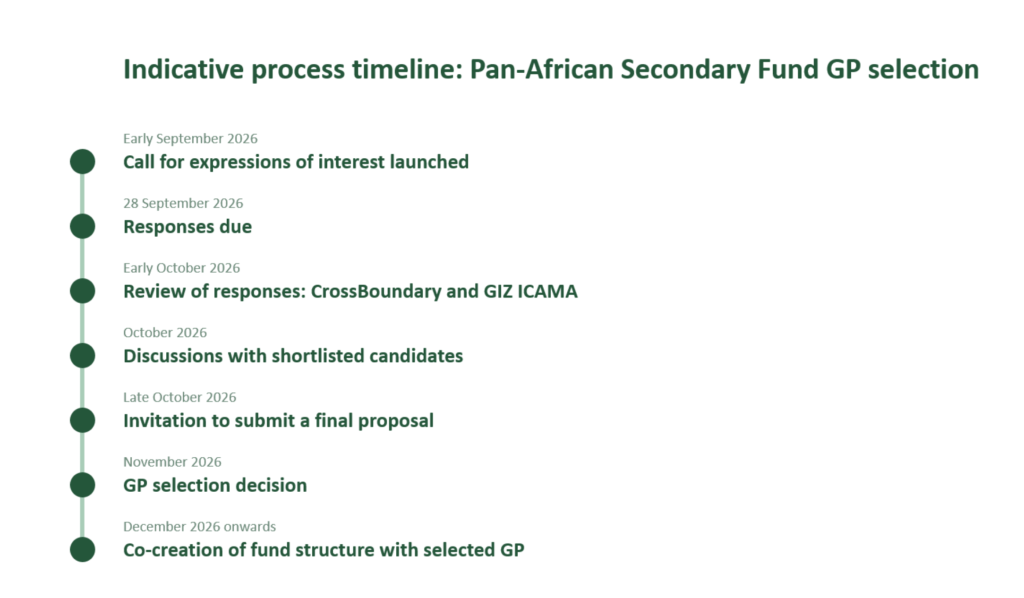
This call is being issued simultaneously via direct outreach to selected fund managers and more broadly through the Taskforce’s networks and social media channels. The process is operationally managed by CrossBoundary on behalf of the Taskforce.
Responses will be reviewed by CrossBoundary and GIZ ICAMA only and will not be shared with other Taskforce members or third parties without the respondent’s prior written consent. Shortlisted respondents will be invited to engage in further discussions with CrossBoundary and GIZ ICAMA. Following these discussions, a small number of candidates may be invited to submit a final proposal, on the basis of which a GP will be selected to co-develop the Fund structure and subsequently manage and fundraise for the vehicle independently.
This call does not constitute a formal procurement process and does not create any obligation on either side. The Taskforce reserves the right to engage additional candidates outside this process, to modify the process, or to discontinue it at any time without providing reasons.
Submission details
Responses should be submitted to frederik.benzel[@]crossboundary.com and david.wolf[@]crossboundary.com by 28 September 2026. Questions regarding this call may be directed to the same address; CrossBoundary will endeavour to respond within five business days.
GIZ’s ICAMA Initiative processes the personal data that you submit with your expression of interest based on public interest (Art. 6(1)(e) GDPR). Submitted data will be processed by CrossBoundary and shared with GIZ ICAMA as part of the review process. For further information on how your personal data is processed by GIZ and how to exercise your rights, please refer to GIZ’s data privacy statement.
CrossBoundary’s role and information handling
CrossBoundary acts solely in its capacity as adviser to GIZ ICAMA for the purposes of this assignment. Respondents should be aware that CrossBoundary operates its own investment activities separately from its advisory business. In accordance with its Conflict-of-Interest Policy, an information barrier is maintained between the advisory team managing this process and CrossBoundary’s asset management activities. Accordingly, information submitted in response to this call will not be accessible to or used by CrossBoundary’s investment teams. Responses will be used solely for the purpose of evaluating candidates for this mandate. CrossBoundary’s data privacy statement is available on request.
6. About the Taskforce and CrossBoundary
GIZ
The Deutsche Gesellschaft für Internationale Zusammenarbeit (GIZ) GmbH is a German federal enterprise with worldwide operations particularly in emerging markets and developing economies. It supports the German Federal Government and many other public and private clients in achieving their goals in international cooperation for sustainable development through providing technical assistance. Together with its partners, GIZ has been developing effective solutions that offer people better prospects and improve their living conditions for more than 50 years. Website Linked
ICAMA Initiative
The Innovative Capital Mobilisation in Africa (ICAMA) Initiative is funded and hosted by GIZ and aims to mobilise capital for African startups and growth firms. Jointly with its partners – such as investors, development finance institutions, fund managers, foundations – ICAMA supports the design and scaling-up of five innovative investment vehicles that address key structural barriers in African private markets. The Initiative was launched at the Hamburg Sustainability Conference 2025, the Africa Early Stage Investor Summit 2025, and during the World Economic Forum 2026 in Davos. ICAMA leads the Taskforce and serves as the sponsor of this assignment.
MEDA
MEDA — Mennonite Economic Development Associates — is a mission-driven “do-tank” that designs and implements market-based solutions to poverty. Unlike traditional think tanks, MEDA’s value proposition lies in execution, enterprise-level problem-solving, and hands-on delivery in emerging and frontier markets. With more than 70 years of operational experience, we straddle development finance and impact investments, combining market-systems expertise with investment-readiness, enterprise support, and disciplined governance approaches. This dual capability enables MEDA to bridge practitioner-level delivery with investment-grade structuring, ensuring that interventions are both developmentally sound and commercially viable. As a Taskforce member, MEDA contributes practical, implementation-focused expertise to fund design and governance, ensuring that structures, processes, and investment approaches are grounded in real-world delivery and informed by decades of experience working with enterprises across diverse markets.
CrossBoundary Advisory
CrossBoundary is a specialist advisory firm focused on unlocking investment in frontier and emerging markets, with a track record spanning energy access, financial services, agribusiness, and broader private markets across Africa and beyond. CrossBoundary is serving as lead adviser and process manager for this assignment under contract to GIZ’s ICAMA Initiative. As process manager, CrossBoundary manages this call operationally, reviews responses jointly with GIZ ICAMA, and has no financial interest in the outcome of the GP selection process.
Related Insights
View all-
 CrossBoundary Advisory03.08.2023White paper
PPA Bankability in Africa: Moving away from Sovereign Guarantees and the Rise of Energy Intermediaries
-
 CrossBoundary Advisory01.06.2021White paper
Investment Facilitation: A new tool for economic development
-
 CrossBoundary Group18.09.2019Publication
Investment Facilitation Revisited