
Getting incentive design right: Lessons from a gender-smart financing pilot for energy access
According to FAO, three in four working women in Sub-Saharan Africa earn their livelihoods through agriculture and food systems. They are also the primary users of energy in the home. Despite this, women remain the least likely to own the productive assets that could change their economic trajectory, largely because financing mechanisms meant to expand energy access are not designed with them in mind. In fact, research by Shell Foundation found that less than 10% of results-based financing funding explicitly targets women.


According to FAO, three in four working women in Sub-Saharan Africa earn their livelihoods through agriculture and food systems. They are also the primary users of energy in the home. Despite this, women remain the least likely to own the productive assets that could change their economic trajectory, largely because financing mechanisms meant to expand energy access are not designed with them in mind. In fact, research by Shell Foundation found that less than 10% of results-based financing funding explicitly targets women.
Closing this gap is central to Shell Foundation’s commitment to enhancing livelihoods for women through productive-use energy, and it was the driving motivation behind the Gender Results-Based Financing pilot. CrossBoundary Advisory led the design and structuring of the pilot, drawing on deep expertise across power and infrastructure, gender smart financing, and innovative financing methods. This project was funded with UK aid from the UK government via the Transforming Energy Access platform.
Why we designed a dual subsidy structure
Existing RBF programs typically incentivize either supply or demand, rarely both –
- Programs focused on distributors drive market entry into underserved segments but do not address affordability at the customer level, or
- Programs focused on end-users improve uptake but do not change distributor behaviour or business models in any lasting way.
Neither approach alone is sufficient to shift the market for women customers, who face barriers on both sides.
The Gender RBF pilot addressed this through a hybrid incentive structure, allocating 70% of the total subsidy to appliance distributors and 30% to end-users.
“To meaningfully shift market behavior, we needed to create both a push and a pull: incentivizing distributors to actively target women while simultaneously making appliances more affordable for women end-users,” said Kirtika Challa, Partner at CrossBoundary Advisory.
How we sized the productive use subsidies
“We wanted the subsidy to have the most impact where it was most needed,” said Aditi Mehta, Senior Associate, CrossBoundary Advisory. “That meant being deliberate about which appliances received more support and why, rather than applying a one-size-fits-all approach.”
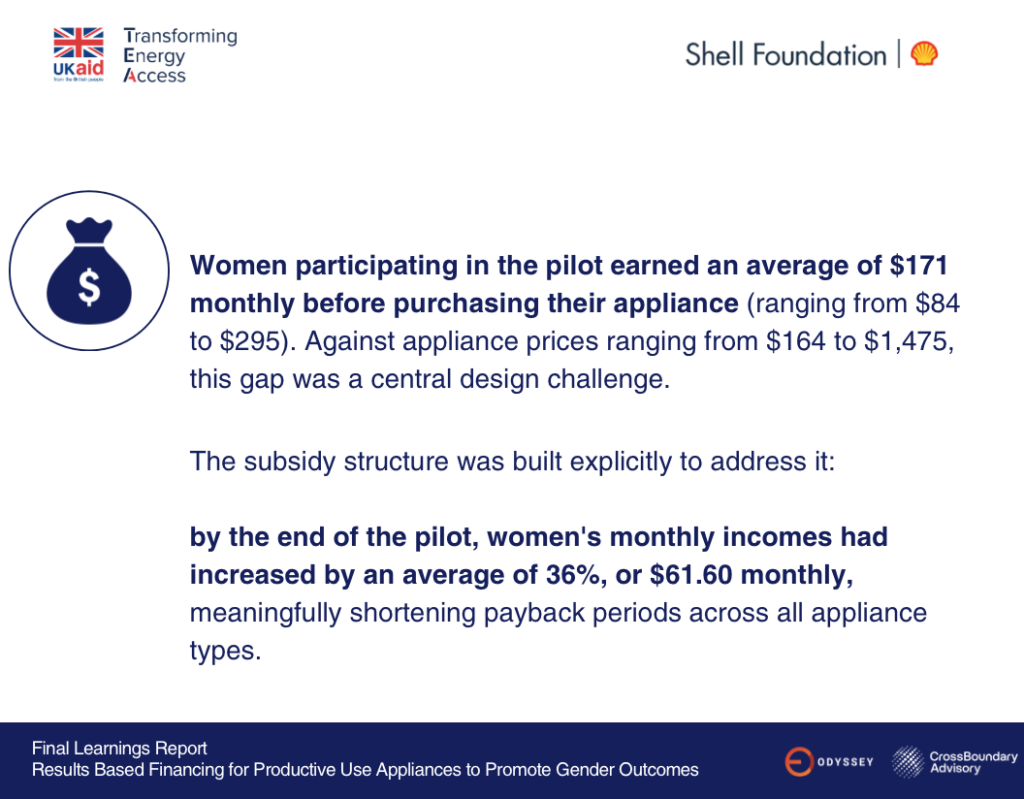
Determining the right subsidy level for each appliance type required a structured approach. Drawing on the landscape analysis of the productive-use energy market, the pilot applied a four-factor methodology to calibrate subsidy sizes across appliance types, resulting in a subsidy range of 30% to 60% of the appliance price.
Income generation potential
The landscape analysis ranked appliances by their income-generation potential. Solar water pumps and ag-processing equipment scored highly due to direct links to productive agricultural output. Cold storage enabled income through food preservation and reduced post-harvest losses. Clean cookstoves, while lower on income-generation potential, were prioritised for their health impact and high market penetration among women.
Price
Prices varied significantly across the four appliances. Higher-priced appliances, such as solarized ag-process equipment and solarized cold storage appliances received larger subsidies to offset affordability barriers that would otherwise exclude lower-income women customers.
Market demand
Appliances operating in less proven markets, with lower penetration and fewer active distributors, such as solarized ag-processing equipment, received additional support to stimulate early market development. Productive use energy appliances remain a relatively nascent area across Sub-Saharan Africa, meaning that for some appliance types, the RBF was not just incentivising sales but actively helping to prove the market.
Availability of other subsidies
Where appliances already benefited from parallel support mechanisms, RBF subsidies were set at relatively lower levels to avoid over-subsidising or displacing existing support. Clean cookstoves, for example, already benefit from carbon credit mechanisms in some markets, which was factored into their subsidy allocation.
Milestone-based disbursements: design rationale and structure
Subsidy disbursements were tied to four key milestones. This milestone-based approach served a dual purpose: it addressed distributor cash flow constraints while ensuring disbursements were tied to key outputs.
The first milestone addressed cash flow directly: an upfront payment at contract signing provided distributors with working capital to absorb the additional costs of targeting women customers.
The second milestone linked disbursement to a verified sale to a woman and submission of baseline survey data, rewarding the intended output (i.e., sales to women), while generating the baseline data needed to measure impact.
The third milestone applied only to clean cookstoves, as sustained use carries a direct cost to the customer. We therefore tied the disbursement to confirmed sustained usage over three months, ensuring subsidy flowed when the appliance was genuinely changing cooking behavior.
The fourth and final milestone was triggered by completion of an endline survey six months post-sale, ensuring that longer-term income, savings and health impact was captured before the final payment was released.
Taken together, this structure meant that subsidy disbursements tracked the customer journey from sale to sustained impact, a design choice that proved its value in the quality of impact data the pilot was ultimately able to generate.
What we learned – reflecting on the end-user subsidy component
The end-user subsidy component was designed to improve affordability by routing discounts from distributors to women customers. In practice, it introduced operational complexity that neither the program team nor distributors had fully anticipated. Integrating discount structures into existing payment plans required pricing adjustments that distributors found burdensome, particularly for those managing multiple appliance types with distinct payment terms.
The resulting pricing changes created confusion among customers, and the temporary nature of the discounts led to sharp increases in monthly instalments once the subsidy period ended, contributing to repayment difficulties and churn.
The longer-term challenge is sustainability. Price reductions tied to a time-bound pilot are difficult to maintain and risk creating unrealistic price expectations in the market once the program ends.
As Shell Foundation noted in their reflections on the pilot, “while the original hypothesis was compelling to test, the pilot revealed significant operational complexities associated with end-user subsidies, particularly in relation to long-term sustainability.” Their conclusion is that enterprise-level incentives, focused on embedding gender-inclusive business models rather than temporary consumer discounts, represent a more sustainable path forward.
What this means for future programs
The Gender RBF pilot demonstrated that intentional design can unlock both social impact and commercial opportunity. A $500K investment enabled approximately 2,500 women to generate an estimated $4.6 million in cumulative income over the life of the appliances, validating the hypothesis that productive-use energy appliances can be a meaningful pathway to women’s economic empowerment.
But the design lessons matter as much as the results. Subsidies directed at the enterprise level, sized against income-generation potential and market conditions, and disbursed against verified outcomes, are more likely to drive lasting change than short-term consumer discounts. For funders and implementers designing similar programs, the key question is not whether to use results-based financing, but how to structure it so that incentives align with the outcomes that matter most.
To explore the complete findings and recommendations from the pilot, read the full Gender RBF Final Learnings Report.
Related Insights
View all-
 CrossBoundary Advisory04.06.2025Article
The Value of Gender Lens Investing in South and Southeast Asia: Opportunities and Lessons from Africa
-
 CrossBoundary Group28.05.2025Publication
CrossBoundary Quarterly: Women in Motion – Power, Progress, and Investment
-
 CrossBoundary Advisory06.03.2024Article
Enhancing livelihoods for women using productive energy use appliances