What the World Bank’s Country Partnership Framework (CPF) Consultations revealed about unlocking private capital in Nigeria
At the World Bank Group's private sector consultations in Lagos, over 100 leaders from across agriculture, energy, finance, manufacturing, healthcare, education, and the creative industries came together to shape Nigeria's 2026–2032 Country Partnership Framework (CPF), focusing on a central question: what will it take to drive private sector-led job creation at scale over the next five to six years?

At the World Bank Group's private sector consultations in Lagos, over 100 leaders from across agriculture, energy, finance, manufacturing, healthcare, education, and the creative industries came together to shape Nigeria's 2026–2032 Country Partnership Framework (CPF), focusing on a central question: what will it take to drive private sector-led job creation at scale over the next five to six years?
Drawing on her experience leading market-shaping and catalytic capital initiatives, CrossBoundary Advisory Principal and Co-Head of Nigeria Advisory, Aishat Raji, reflects on what the emerging CPF signals for investors seeking opportunities amid Nigeria’s shifting macroeconomic landscape.
Why the CPF Matters for Investors
The CPF is the World Bank Group’s five-year blueprint for how it will deploy resources, shape reform priorities, and accelerate sector development. For investors, this framework is an early indicator of:
- Which sectors will benefit from upstream technical assistance and policy focus
- Where blended and catalytic capital may be deployed to de-risk private investment
- How Nigeria aims to reshape its enabling environment to attract domestic and foreign capital
The outgoing CPF (2021–2025) concentrated on poverty reduction and institutional strengthening. The upcoming 2026–2032 CPF has a sharper emphasis on accelerating private sector participation across infrastructure, energy transition, digital infrastructure, manufacturing, agriculture, and the creative economy.
With global capital tightening and Nigeria implementing bold macroeconomic reforms, the CPF’s direction is clear: align interventions with market realities and create the conditions for investable projects to scale.
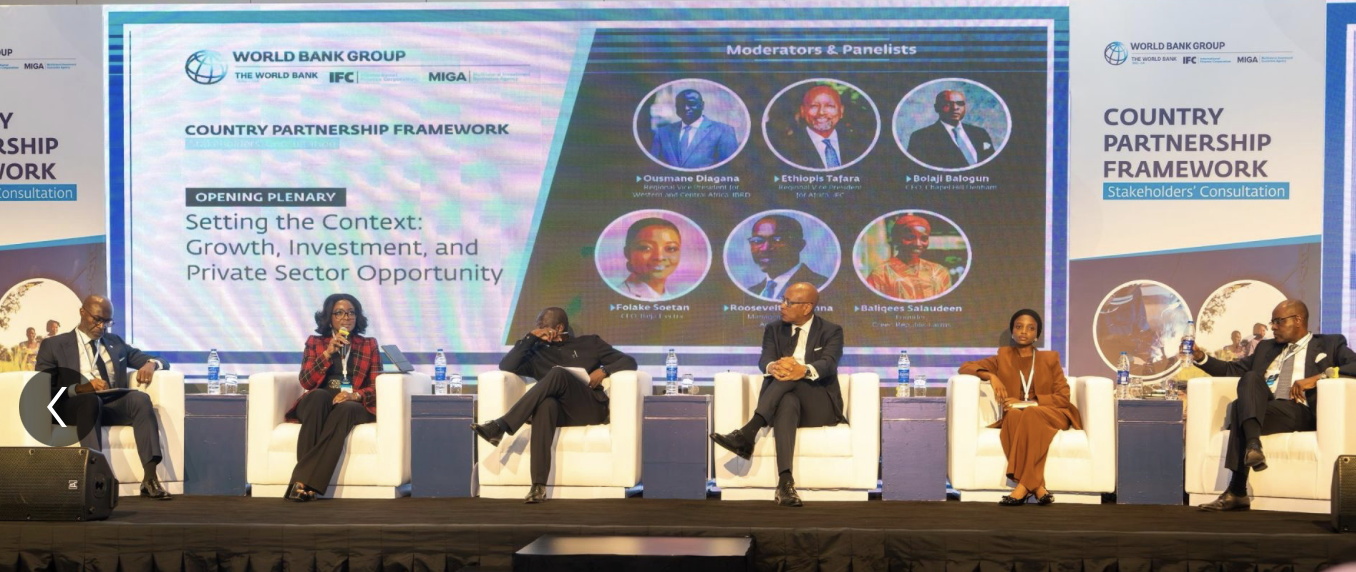
The consultations were deliberately sequenced across three sessions. The opening plenary framed Nigeria’s macroeconomic position and the structural constraints still holding back private sector-led growth. Two panels followed: one on unlocking priority sectors for jobs and diversification, the other on the human capital foundations that make growth durable. Senior World Bank Group and IFC leadership, including Ousmane Diagana and Ethiopis Tafara, Dahlia Khalifa and Matthew Verghis, moderated sessions alongside capital allocators like Bolaji Balogun and Roosevelt Ogbonna.
Five insights investors should pay attention to
When is small business big business?
Over 90% of Nigerian enterprises are MSMEs. The market question is not whether to support them, but how to build financing structures that can move volume sustainably.
For investors, scalable MSME financing remains one of Nigeria’s highest-potential yet underserved opportunities and is inseparable from the broader job creation agenda.
Energy reliability will determine sector competitiveness
From agri-processing facilities to emerging data centres, power reliability surfaced as a core risk for investors underwriting assets in Nigeria. Without predictable, affordable energy, productivity stalls and competitiveness deteriorates, regardless of how strong the investment case is on paper.
Data sovereignty is a domestic infrastructure opportunity
A significant share of Nigeria’s data is processed and stored offshore. This is simultaneously a sovereignty concern and a competitiveness gap, and that dual framing matters. Investments in domestic fibre, processing capacity, and data centre infrastructure are not just national security priorities; they are investable infrastructure plays that can attract both government mandate and private capital. That positioning is rare, and it is what makes this opportunity particularly compelling for investors tracking where government intent and market return align.
Catalytic capital works, when structured for additionality
Examples like IFC’s portfolio-based first-loss structures demonstrate how DFIs can mobilize private capital (via commercial banks) at scale rather than displace it.
The lesson for investors: well-designed blended finance structures are becoming more sophisticated and more targeted, enabling higher risk-adjusted returns. CrossBoundary Advisory sees this dynamic play out across markets every day: the structure of the intervention is as important as the capital itself.
The cost of capital is still the binding constraint
Agribusinesses and creative enterprises in particular cannot scale without affordable, risk-adjusted financing.
A CPF that seeks to prioritize these sectors must address this head-on with practical de-risking instruments that bring the cost of capital within reach.
What Nigeria’s inflection point demands
The 2026–2032 CPF is being shaped at a critical moment. Nigeria has undergone significant macroeconomic reform. The structural adjustments are painful and still working through the system, but they are beginning to create a more rational operating environment for private capital. The next step is translating that policy momentum into deployable investment, and that requires four things to converge:
- Predictable enabling conditions that reduce transaction costs for investors
- Investable sector platforms with credible pipeline and deal structure
- Strengthened human capital that allows productivity gains to compound
- Well-designed capital structures that crowd in, not crowd out, domestic and institutional investors
In CrossBoundary Advisory’s work, catalytic capital and upstream technical assistance must work together to unlock private investment sustainably. Aishat noted it was encouraging to see those themes reflected clearly in the dialogue, and to see the World Bank Group approaching this CPF not as a lending exercise, but as a market-building mandate.
Related Insights
View all-
 CrossBoundary Advisory16.10.2024Blog
CrossBoundary engages with investors in Laos on unlocking climate finance into the country to support the government’s NDC priorities
-
 CrossBoundary Group30.01.2024Opinion
CrossBoundary Compass: Perspectives on 2024
-
 CrossBoundary Group18.09.2019Publication
Investment Facilitation Revisited